Products
Open-air cinema
Organize a screeningFree or ticketed?Start an outdoor cinemaCampsites & holiday parksBeach cinemaOpen-Air Movie ScheduleAccessories & tools
AccessoriesCinema packagesComprehensive solutionsScreen rentalComparisonInstructions for useTools
Screen ConfiguratorTent ConfiguratorFurniture ConfiguratorLounge configuratorArch configuratorAirtight side viewBlower side viewThe company
Comparison
The alternative to AIRSCREEN®:
the same 40 ft, 177 lbs versus 249
Hallucine was born in 1992 in La Mure, Isère, and has been selling its inflatable cinema screens since 1995. This page compares one screen, just one, size for size: our 40 ft and the AIRSCREEN classic 40 ft (12 m). All the competitor's figures come from its public technical data sheet, ours from our configurator. Both documents are at the bottom of the page. Where we are tied, it says so too.
PDF guide
Choose the right inflatable screen
A public guide generated from the CRM to compare ranges, noise, wind use, applications and logistics before requesting a quote.
A 40-foot screen, two ways to carry it
The 40-foot size is the only one where our two ranges overlap exactly: a 40 ft screen on their side, 40 ft on ours. The comparison is therefore made on strictly equal terms, without pitting our best model against their heaviest one.
A line nobody looks at: the format
Their classic screen has a 2:1 format. A film in the 1.85 cinema format only fits at 37 ft wide, a 16:9 program at 36 ft: the height stops at 20 ft. Ours is 23 ft high, so both fit at 40 ft wide. For the same advertised screen width, the projected image is 17 % bigger on our side in cinema format, 27 % in 16:9.
The ground you need to set it up
For a 40-foot screen, their technical data sheet lists a “space required for operation” of 73 ft wide by 60 ft deep. Ours needs 46 ft wide by 33 ft deep. That is what makes the difference between a village square, an inner courtyard, a rooftop or a boat deck becoming viable — and a screening that has to be moved elsewhere. No pallet truck, no forklift, no crane: lightness is enough.
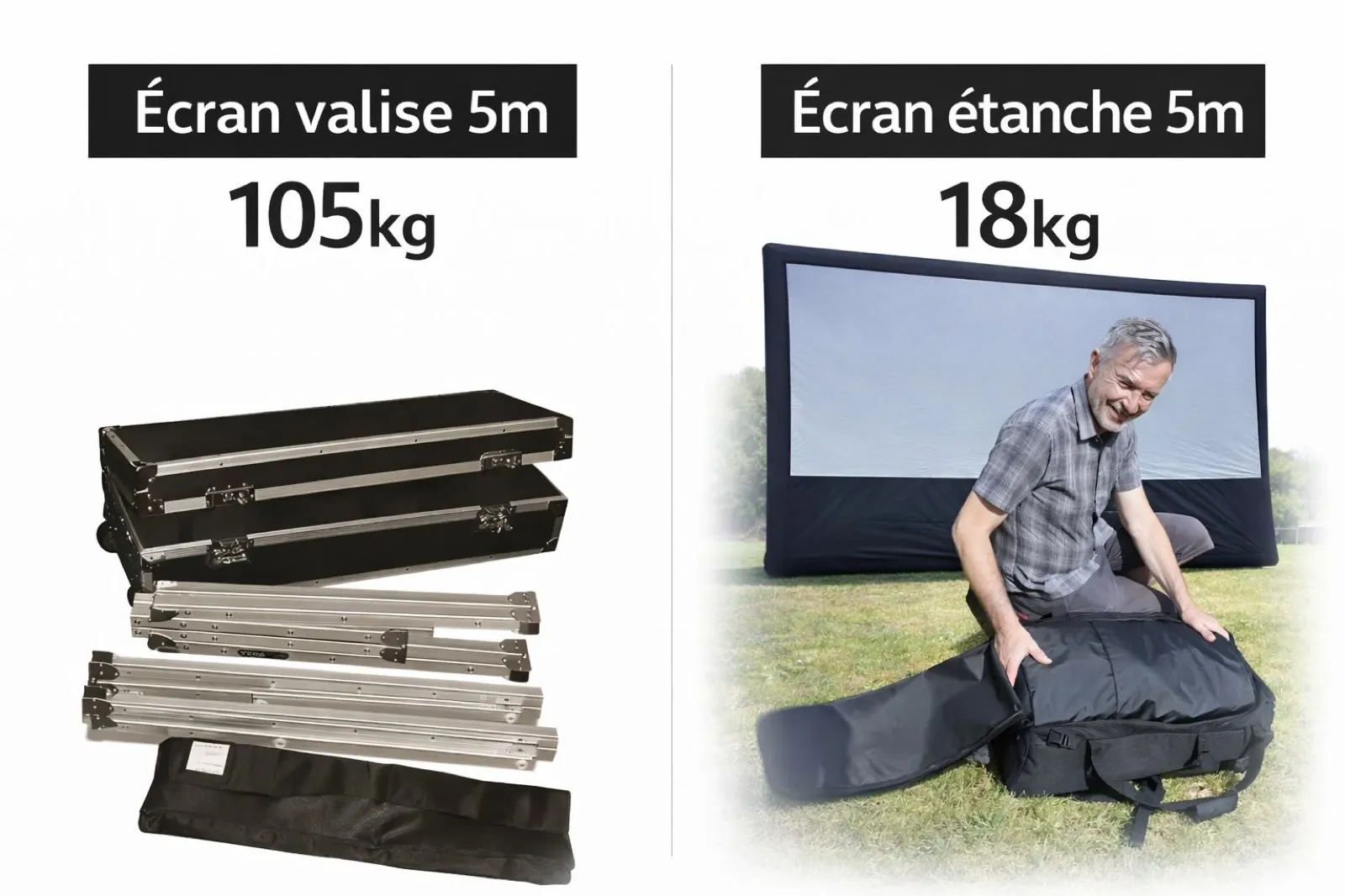
What 169 kilos change in the field
Size doesn't say everything. Two 40-foot screens look alike on a spec sheet; on the projection site, they don't demand the same organization. A heavy screen has to be moved, positioned, raised, secured, then folded back up — and every step is counted in arms and minutes.
Yet the screen is only part of the job. There is the projector, the sound, the cables, welcoming the audience, safety, the weather, sometimes the permits. If the screen keeps several people busy for an hour, the whole evening has to be reorganised around it. And takedown comes late, when the team is tired: that is when movements become dangerous and work stoppages happen.
The number of people involved is therefore not a technical detail. It is a real cost: in time, energy, logistics, and working comfort. A lighter screen gives the team the leeway needed to manage the rest of the event.
A screen that lasts twenty years
A screen is not a consumable to be replaced every two years. Some of our clients are still projecting with the fan screen they bought from us over twenty years ago. There are four reasons for this.
Warranty
Ten years. Not two, not five. We offer it because we know what we build, and we stand behind it at no extra cost.
The fabric
High-tenacity polyamide 6.6 — DuPont de Nemours yarn —, ripstop weave, polyurethane coating: the airbag fabric family. The ripstop stops the tear instead of letting it run. Wind, rain, cold, heat: the fabric does not give in.
Lightness
It is not a sign of fragility: it is the result of smarter weaving, not weaker material. A flexible screen bends under the gust instead of resisting it.
The express setup
Less time setting up, less time taking down, less worn-out crews, back-to-back dates without wearing out the equipment. The equipment should work for you, not the other way around.
Two screens, two trades
Our screen
Screen fabric: Dacron® 250 D, 130 g/m², gain 1.2, fastened with Velcro — it stays in place from one screening to the next, and it's machine washable. The fabric widths are sewn together. Structure: high-tenacity polyamide 6.6, DuPont de Nemours yarn, ripstop weave, 210 g/m² — the fabric used in airbags.
Theirs
Screen fabric: matte PVC with black backing, gain 0.96. Their spec sheet lists 93 lbs for 776 sq ft — about 580 g/m². It attaches via eyelets every 8 in and 290 bungee cords on a 40-foot screen, and is taken down after each screening. Structure: the same kind of tarpaulin PVC, in the region of 600 g/m², for a 457 lbs frame.
What they do better than us
A comparison that says only good things about its author is worthless. Three points, honestly.
Their frame has no seams
It is high-frequency welded. Our fabric panels are sewn, and the seam shows if the screen is not properly tensioned: tension during setup matters to us, not to them.
Their international network
Rental companies and distributors in many countries. On our side, a seam is mended on the spot with a needle and thread, and the warranty runs for ten years. A high-frequency weld goes back to the workshop: that evening's screening is lost.
Two lines where nobody wins
Wind resistance is 24 mph — force 5 — on both sides, and both screens are B1 fire-rated. Beyond 24 mph, the rule is the same everywhere: deflate.
The difference, in pictures
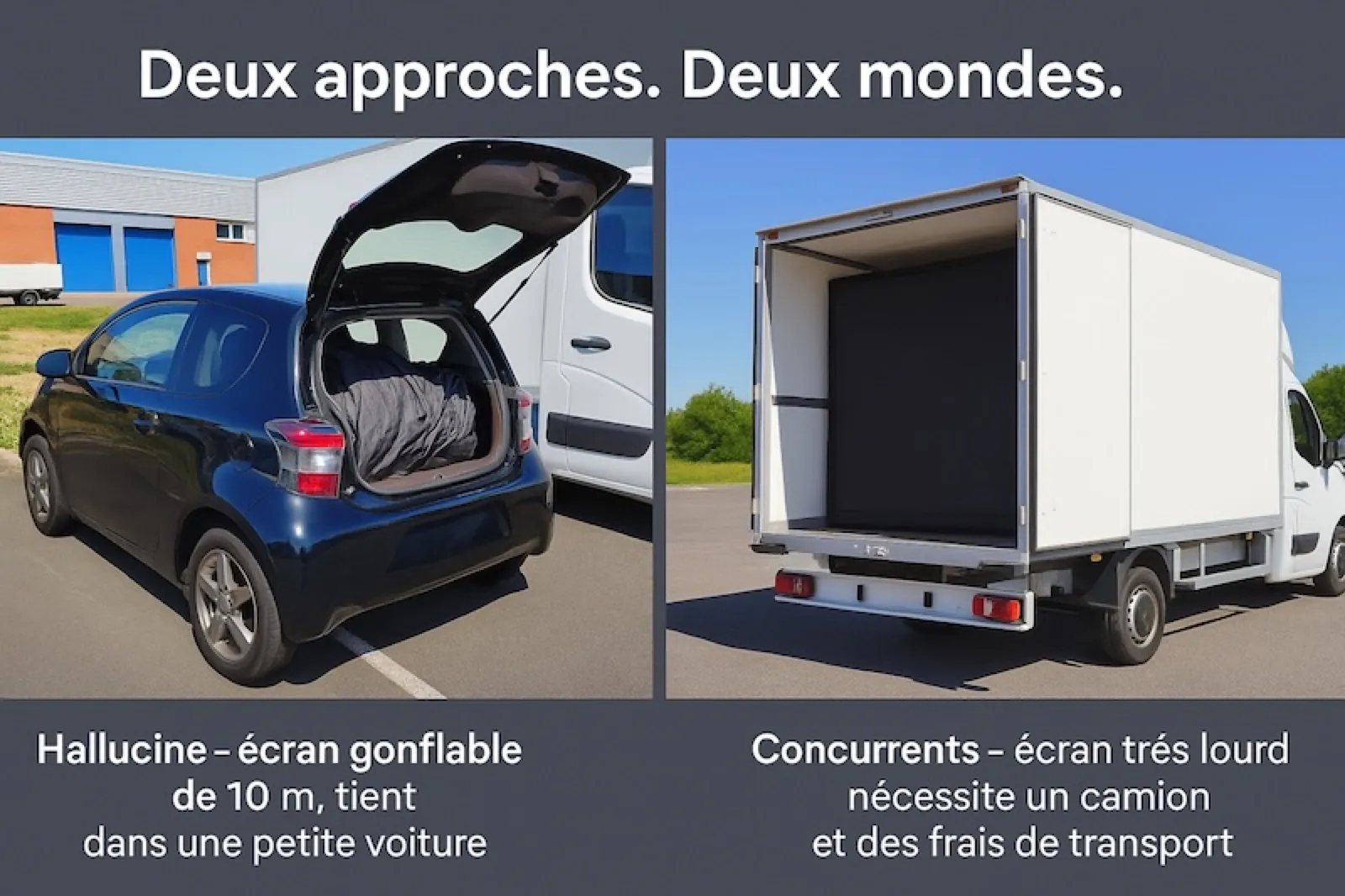
Transport and handling: what concretely changes between an Hallucine screen and a traditional screen.
A manufacturer, not a catalog
Hallucine is a family business founded in 1992 in La Mure, in the Isère region. We started out running our own open-air cinema screenings: the first screens were built for us, for our tours, and it was only in 1995 that we sold one. That's the sole reason they weigh what they weigh — we were the first to carry them. The range now runs from 7 to 73 ft, and our customers screen in over forty countries.
Benefits for your events
Unique atmosphere
Create a unique atmosphere for your screenings or presentations. The giant inflatable screen turns any venue into a movie theater.
Indoors and outdoors
Suitable for outdoor and indoor events. Festivals, drive-ins, weddings, conferences, product launches.
Professional image
Impress your guests with professional, attractive equipment. Over thirty years of expertise at the service of your events.
Frequently asked questions
What is the alternative to AIRSCREEN?
A Hallucine screen with the same tarp width: 177 lbs versus 549 lbs at 40 ft, a ten-year warranty versus two, and a tarp attached with Velcro instead of 290 bungee cords.
Three times lighter, but three times more fragile?
No. It's a high-tenacity 6.6 polyamide with a ripstop weave, from the airbag fabric family, not a thinner fabric. That's what the ten-year warranty is for.
How much space is needed for a 40-foot screen?
46 × 33 ft. The AIRSCREEN data sheet lists a “space required for operation” of 73 × 60 ft for the same screen width.
How many people are needed to set up a 40-foot screen?
Just one, in forty minutes.
And in strong wind?
24 mph, or force 5, for both screens: the limit is the same, and they state it just like us. Beyond that, we deflate.
What if the screen gets punctured?
On a blower screen, a small hole changes nothing: the blower compensates continuously. This is true for them as it is for us.
Should the screen fabric be removed after each screening?
No, it stays in place, and it's machine washable.
Sources
All figures attributed to the competitor come from documents it publishes itself, recorded on August 16, 2026. Ours come from our screen configurator.
- Technical data sheet AIRSCREEN (PDF)
- Warranty AIRSCREEN (PDF)
- Size chart AIRSCREEN
- Product page AIRSCREEN classic
- Our screen configurator
AIRSCREEN® is a registered trademark of The AIRSCREEN Company GmbH & Co. KG, Münster, Germany. Hallucine has no affiliation with this company. Comparison made on 16 August 2026 from documents published by both manufacturers.
See what it looks like for your project
The configurator gives you the right screen size for your audience in one minute. Otherwise, tell us about your project — we reply within 24 hours.