Products
Open-air cinema
Organize a screeningFree or ticketed?Start an outdoor cinemaCampsites & holiday parksBeach cinemaOpen-Air Movie ScheduleThe live skyAccessories & tools
AccessoriesCinema packagesComprehensive solutionsScreen rentalComparisonInstructions for useTools
Screen ConfiguratorTent ConfiguratorFurniture ConfiguratorLounge configuratorArch configuratorAirtight side viewBlower side viewThe company
Choosing the Right Technology
Inflatable screen or LED screen?
These two options are often presented as competing alternatives. They are not: they operate at different times. So the question isn't “which one is better,” but “what time does your session start?” Everything else—logistics, budget, image—follows from that.
Request a free quoteThe Test, in One Question
Does your session start before or after dark? Not after sunset—after dark, which occurs 30 to 45 minutes later.
Before the Dark of Night
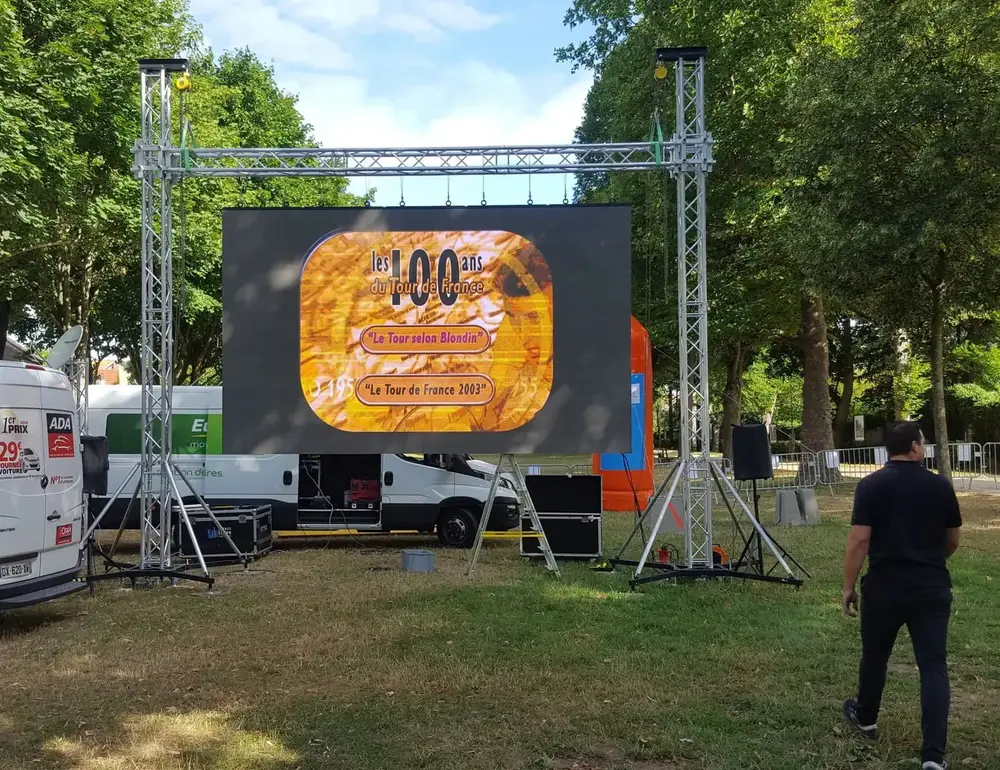
A 9 p.m. game, an afternoon fan zone, a conference, the mayor’s New Year’s address, and Christmas market activities: there’s still plenty of daylight left. A video projector, no matter how powerful, will produce a washed-out image. That’s where LEDs come in—they generate their own light instead of competing with the light from the sky.
After the Dark Night
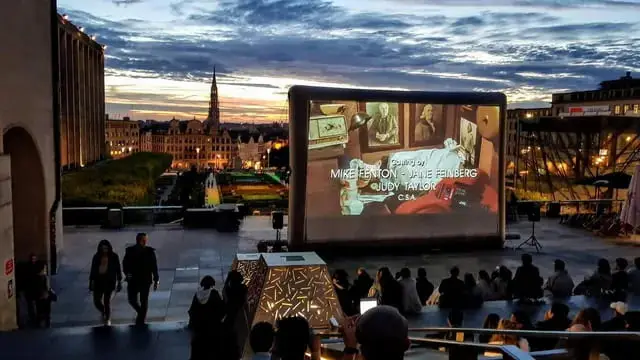
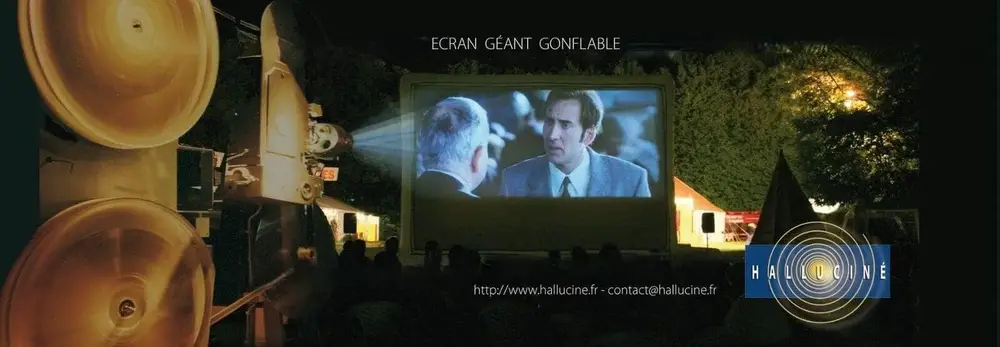
Open-air cinema, drive-in, festival screenings: this projection solution offers all the advantages—surface area, cost per square meter, weight, and setup. A 40-foot inflatable screen weighs 177 lbs and can be set up in 40 minutes. No LED screen of this size comes close to that figure.
A concrete example: On July 14 in Lyon, the sun sets at 9:28 p.m., but it doesn’t get completely dark until 10:04 p.m. A screening scheduled for 9:30 p.m. takes place during twilight—which is not ideal. On June 21, it’s even worse: 10:12 p.m.
The Hour-by-Hour, Month-by-Month Breakdown →On a case-by-case basis
| Your session | What You Need | Why |
|---|---|---|
| Open-air movie theater, summer | Inflatable | The session starts after 9:30 p.m. anyway: the night does the work, and the space costs ten times less. |
| Daytime game or competition | LED | The game time is non-negotiable. This is the only situation where the broadcast is doomed to fail from the start. |
| Fan Zone from morning to night | LED | The screen should last all day, not just in the evening. It shouldn't just switch over at nightfall. |
| Drive-in | Inflatable | You need a very large image when viewed from a distance, and the shoot takes place at night by its very nature. Our elevated camera platform is designed for rows of cars. |
| Conference, room, lobby | It depends on the lighting | If you can dim the lights, the projection will produce a larger image for the same budget. Otherwise, use LEDs. |
| Commemoration, Season's Greetings, Late Afternoon in Winter | By month | In December, it gets dark around 5:30 p.m., so it’s possible to watch a movie very early. In June, that’s not the case. |
How much each one costs to install
The purchase price isn't the only difference. What you pay each time is for the assembly.
Weight
Our blower-powered screens range from 78 lbs for a 23-foot screen to 618 lbs for a 73-foot screen, including the frame and fabric. An LED facade of equivalent surface area consists of panels, a supporting structure, and ballast: you don’t carry it—you lift it.
The Montage
An inflatable structure takes 30 to 90 minutes to set up, depending on its size, and can accommodate up to one person at a distance of up to 40 ft. An LED facade is assembled tile by tile onto a frame and requires a team.
Food
The inflatable uses only its blower, which runs continuously and consumes very little power. The LED’s power consumption depends on its surface area and brightness throughout the entire display: this is a cost factor to consider based on the venue, not just a power outlet.
The Setback
That’s the key advantage of LEDs—and it’s often overlooked: they don’t require any projection distance. Whereas a video projector needs several meters in front of or behind the audience, an LED screen can be mounted right against a wall. In a narrow courtyard, that alone makes all the difference.
What about the picture?
Two common misconceptions that should be dismissed—on both sides.
LEDs aren't "prettier"
It’s brighter. On film, in the dark, a projection produces deeper blacks and a softer image—that’s the look we associate with the movies, and it’s not just nostalgia: it’s the difference between an emitted image and a reflected image.
The projection is not “outdated”
It’s conditional. Meet its requirements—nighttime, a little distance, a stretched screen—and it produces twenty times the surface area of an LED screen at the same price. That’s why movie theaters still show films on the big screen.
The Budget
We do not publish flat-rate pricing, but the order of magnitude is clear: per square meter of image area, LED is significantly more expensive than projection, whether you’re buying or renting. That’s the cost of light. So the question to ask isn’t “how much,” but “do I really need to project in broad daylight?” If the answer is no, LED technology is an unnecessary expense.
Describe my session and get a quoteWhat we do is—
Both, with no commercial preference: we have been designing our inflatable screens since 1992 and supply event LED. That is precisely why we can tell you when LED is useless — a vendor offering only one of the two solutions would not say so.
Your Questions
Can you project in broad daylight using a very powerful video projector?
No, not satisfactorily. The problem isn’t the projector’s brightness, but rather the ambient light: it illuminates the screen at the same time as the projector and washes out the blacks. You can improve things slightly by shading the screen, but never enough for a picture in broad daylight. That’s where LED comes into play.
What time does a movie actually start?
At the end of civil twilight, when the sun is 6° below the horizon—that is, 30 to 45 minutes after sunset, not at sunset itself. On July 14 in Lyon, this means 10:04 p.m., with sunset at 9:28 p.m. Our guide publishes the table month by month.
Is an LED screen more wind-resistant?
It works differently: an LED facade is a rigid, weighted structure, while an inflatable screen is a sail that can be deflated. Ours can withstand winds of up to 24 mph—or force 5—and when the wind gets stronger, we lay it flat—a quick and damage-free process. An LED structure, on the other hand, must be taken apart.
Is it better to rent than to buy?
Yes, for both technologies, and this is often the right choice when the need for daylight is occasional: one fan zone per year doesn't justify buying an LED facade.
What about mixed use—day and night?
While both setups are used every year, it’s common to have an inflatable screen for nighttime screenings—which are the most frequent—and to rent LED screens for the rare daytime screenings. It’s almost always cheaper than using LED screens for everything.
Let us know what time you plan to
The time, the place, the audience: with these three pieces of information, we'll tell you which of the two technologies is right for you—even if it means selling you the cheaper one.
Request a free quote